Index regulator vs free sprung balance is one of the most useful comparisons for understanding how a mechanical watch movement is regulated. Although both systems control the rate of a mechanical movement, they use fundamentally different methods to adjust the balance and hairspring assembly.
When comparing mechanical watch movements, many buyers first look at the caliber name, power reserve, beat rate, or movement finishing. However, the regulating system can reveal just as much about how a movement is designed and adjusted.
Two important approaches are the index-regulated balance and the free-sprung balance. Understanding how they differ can help you evaluate movement architecture, adjustment methods, service requirements, and real-world mechanical performance.

What Does a Mechanical Watch Regulating System Do?
A mechanical watch does not use an electronic oscillator to establish its timekeeping rate. Instead, the balance wheel and hairspring form an oscillating system that works together with the escapement.
The balance repeatedly rotates in both directions while the hairspring expands and contracts. This repeating motion provides the timing reference used by the mechanical movement.
If the watch is running faster or slower than intended, the rate may need to be regulated. This is where the difference between an index regulator and a free-sprung balance becomes important.
What Is an Index Regulator?
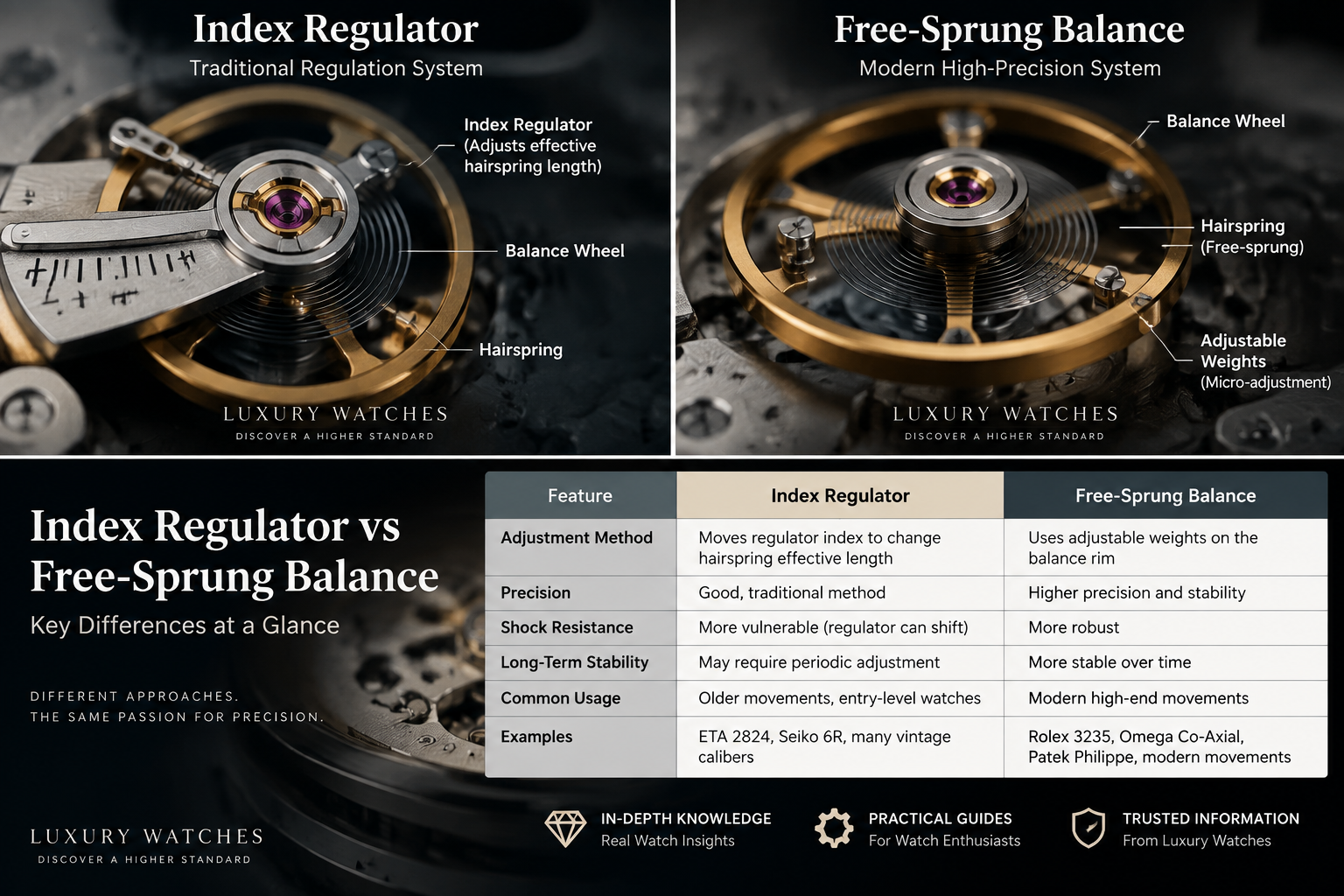
An index regulator is a traditional and widely used method of regulating a mechanical watch movement.
The system generally uses a movable regulator together with curb pins positioned around the outer portion of the hairspring. Changing the position of the regulator alters the effective portion of the hairspring participating in the oscillation.
Shorter effective hairspring → higher rate
Longer effective hairspring → lower rate
This provides a relatively direct method of making rate corrections without changing the inertia of the balance wheel itself.
How to Recognize an Index-Regulated Movement
The exact appearance varies from one caliber to another, but several features can help identify a conventional index-regulated movement.
- A movable regulator arm near the balance assembly
- Curb pins interacting with the outer portion of the hairspring
- Rate markings such as + and − on some movements
- A separate stud or stud carrier securing the outer end of the hairspring
Because movement layouts differ considerably, the number of visible posts or screws should not be used as the only identification method.
Advantages of an Index Regulator
Advantages
- Established and widely understood architecture
- Relatively straightforward rate adjustment
- Familiar to many experienced watchmakers
- Can deliver very good performance when correctly regulated
- Often simpler to manufacture and service
Considerations
- The hairspring interacts with the regulator and curb pins
- Correct curb-pin geometry and clearance are important
- Strong impacts may potentially affect regulation
- Performance still depends on amplitude, position, condition and adjustment
What Is a Free-Sprung Balance?
A free-sprung balance uses a different approach to regulating the movement. Instead of using a conventional regulator to change the effective working length of the hairspring, rate adjustment is performed through the balance wheel itself.
Depending on the caliber, the balance may use adjustable screws, weights, inertia blocks, or another manufacturer-specific adjustment system.
Changing these components alters the moment of inertia of the balance wheel, which in turn changes its oscillation rate.
More balance inertia → slower oscillation → lower rate
Less balance inertia → faster oscillation → higher rate
Not every free-sprung system is adjusted in exactly the same way. Some designs alter the orientation of small inertia weights rather than simply moving a conventional screw inward or outward.
How to Recognize a Free-Sprung Balance
Two characteristics are particularly useful when examining a movement:
- There is no conventional index regulator being used to change the active length of the hairspring.
- The balance wheel incorporates an adjustable inertia system.
Depending on the movement, visible components may include:
- Adjustable weights positioned around the balance
- Timing or regulating screws
- Recessed or protruding inertia blocks
- Manufacturer-specific micro-adjustment systems
Index Regulator vs Free Sprung Balance: Key Differences
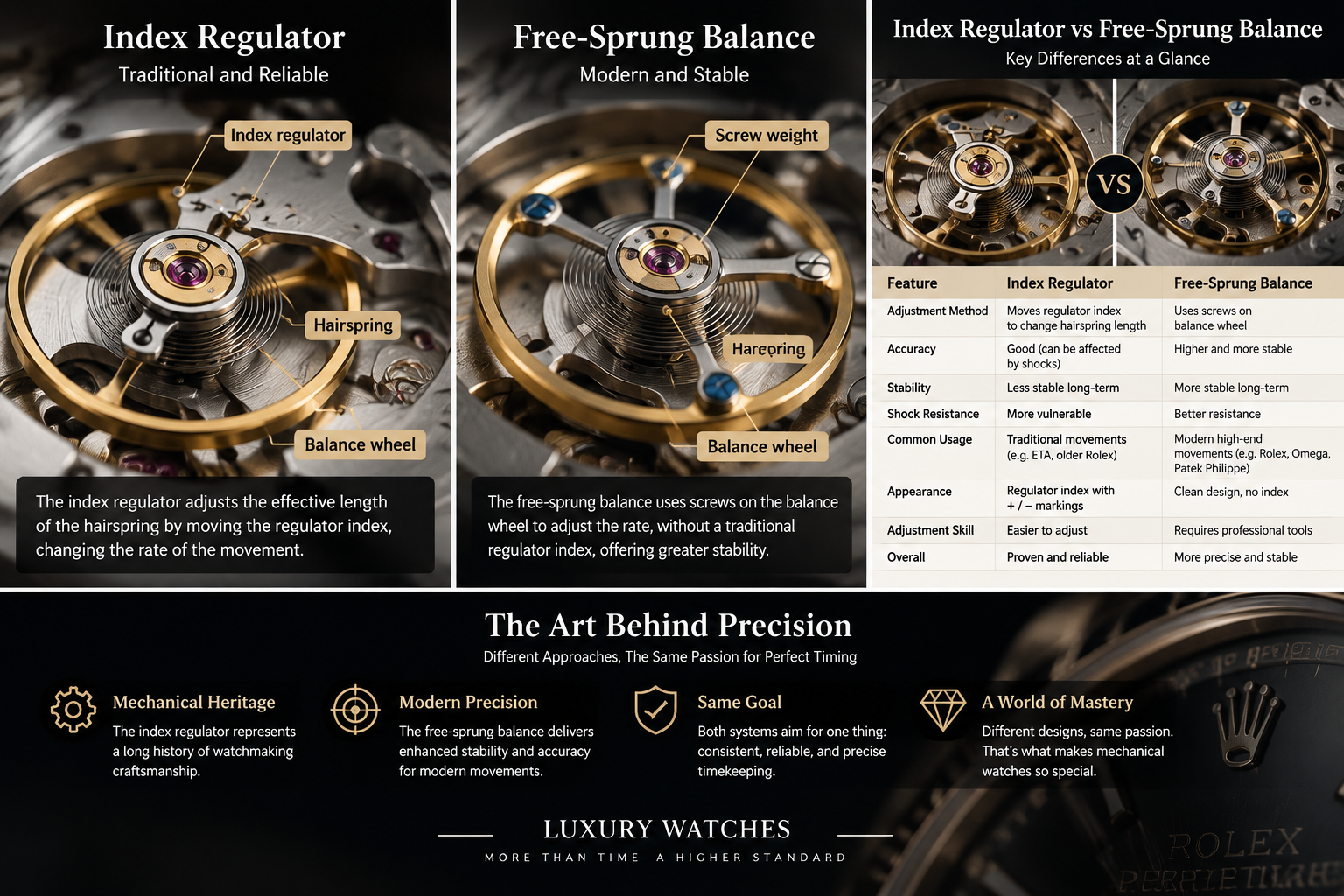
The most important difference between an index regulator vs free sprung balance system is not simply how the components look. It is the mechanical principle used to change the rate of the oscillator.
| Feature | Index Regulator | Free-Sprung Balance |
|---|---|---|
| Regulation Principle | Changes effective hairspring length | Changes balance-wheel inertia |
| Regulator Arm | Usually present | Normally absent |
| Curb Pins | Normally used | Not used for conventional index regulation |
| Hairspring Length During Regulation | Effective working length is adjusted | Active length remains essentially fixed |
| Rate Adjustment | Move or adjust regulator mechanism | Adjust balance weights or inertia components |
| Basic Regulation | Generally more straightforward | Generally more specialized |
| Manufacturing | Often simpler | Can require more specialized manufacturing and adjustment |
| Servicing | Widely familiar to watchmakers | More dependent on the specific caliber and adjustment system |
| Typical Application | Used across a wide range of mechanical movements | Common in many modern proprietary and higher-end calibers |
Does a Free-Sprung Balance Keep Better Time?
Not automatically. This is one of the most important points to understand when comparing mechanical movements.
The regulating architecture is only one part of the complete timekeeping system. Real-world rate performance can also be influenced by:
- Hairspring geometry
- Balance construction
- Amplitude
- Escapement condition
- Lubrication
- Positional adjustment
- Temperature
- Magnetism
- Shock
- Manufacturing tolerances
- Final regulation
Why Do Many High-End Movements Use Free-Sprung Systems?
Removing the conventional index regulator changes how the hairspring and balance assembly are designed and adjusted.
Instead of changing the hairspring's effective working length through curb pins, rate adjustment can be integrated directly into the balance through adjustable inertia components.
For manufacturers developing complete proprietary calibers, this approach can provide greater freedom in oscillator design and adjustment strategy.
Free-sprung systems can also require precise manufacturing and careful regulation, which is one reason this architecture is frequently associated with more technically ambitious mechanical movements.
That does not mean the balance design alone determines the quality of a watch. The movement should always be evaluated as a complete mechanical system.
Shock Resistance and Long-Term Stability
A conventional index regulator contains movable regulating components. A sufficiently strong impact may potentially affect the regulator, hairspring, or other parts of the oscillator.
A free-sprung design removes the conventional index from the rate-regulation process and instead relies on calibrated components on the balance.
However, this does not make a free-sprung mechanical movement shock-proof.
The balance staff, pivots, jewels, escapement and hairspring remain delicate mechanical components. The overall shock-protection system and movement construction therefore remain important regardless of regulation type.
Is a Free-Sprung Balance Harder to Adjust?
In many cases, yes. Free-sprung regulation generally requires familiarity with the specific caliber and its inertia-adjustment system.
With many conventional index-regulated movements, a watchmaker can make a rate correction through the regulator and then measure the result on a timing machine.
A free-sprung movement instead requires controlled adjustment of the balance weights or other inertia components.
Proper regulation may require:
- Knowledge of the specific caliber
- Appropriate watchmaking tools
- A timing machine
- Small and controlled adjustments
- Testing in multiple positions when appropriate
Incorrect adjustment can introduce additional timing problems rather than improving the movement's performance.
What Should Watch Buyers Actually Look At?
When comparing mechanical watches, the words free-sprung should be treated as one technical characteristic rather than the sole reason to choose one movement over another.
1. Caliber Architecture
Identify the actual caliber and examine how its balance, hairspring, escapement, winding system and regulating architecture work together.
2. Beat Rate
Common mechanical frequencies include 21,600 and 28,800 vibrations per hour, although other frequencies are also widely used.
Beat rate is useful technical information, but a higher frequency does not automatically mean a better movement.
3. Power Reserve
Consider how long the movement is designed to operate after being fully wound and whether that reserve suits the way you plan to wear the watch.
4. Actual Rate Performance
When accuracy matters, actual timing results are more useful than assumptions based only on the regulating architecture.
5. Amplitude and Beat Error
Timing-machine measurements such as amplitude and beat error can provide additional information about the condition and regulation of a mechanical movement.
6. Serviceability
A technically sophisticated caliber is not automatically the easiest movement to maintain. Parts availability, watchmaker familiarity and adjustment complexity should also be considered.
Why This Difference Matters When Comparing Movements
Two watches can appear very similar from the dial side while using substantially different movement architectures.
Looking through a transparent caseback or examining detailed movement photographs can reveal differences in:
- Balance construction
- Regulating mechanism
- Hairspring arrangement
- Bridge architecture
- Rotor construction
- Movement finishing
- Jewel placement
- Shock protection
- Overall caliber layout
For buyers interested in mechanical construction rather than appearance alone, understanding the regulating system provides another useful way to evaluate what is actually happening inside a watch movement.
Frequently Asked Questions
What is the main difference between an index regulator and a free-sprung balance?
An index regulator primarily changes the effective working length of the hairspring. A free-sprung system normally keeps that length essentially fixed during regulation and adjusts the inertia of the balance wheel instead.
Is a free-sprung balance always better?
No. It is a different and often more specialized regulating architecture, but actual accuracy and reliability depend on the complete movement, manufacturing quality, condition and final regulation.
Can an index-regulated movement be accurate?
Yes. A properly manufactured and correctly regulated index movement can provide very good mechanical timekeeping.
How can I identify a free-sprung balance?
Look for the absence of a conventional index regulator together with an adjustable inertia system on the balance wheel. Because designs differ, documentation for the specific caliber is still the best reference.
Can I regulate a free-sprung balance myself?
Regulation is generally best handled by an experienced watchmaker using the correct tools and timing equipment. Small changes to the balance can produce meaningful rate differences.
Does free-sprung automatically mean a more expensive movement?
Not automatically. Free-sprung construction can increase manufacturing and adjustment complexity, but movement cost depends on many other factors.
Which regulating system should I choose?
For most buyers, regulation type should be one consideration rather than the only deciding factor. Reliability, actual timing performance, serviceability, power reserve and overall movement construction are also important.
For additional background on terminology and standards within the Swiss watch industry, visit the Federation of the Swiss Watch Industry FH .
Final Thoughts
The fundamental difference between an index regulator vs free sprung balance system is the method used to alter the rate of the mechanical oscillator.
An index-regulated movement primarily changes the effective working length of the hairspring. A free-sprung system leaves that length essentially fixed during normal regulation and instead changes the inertia of the balance wheel.
Both approaches can perform extremely well when properly designed, manufactured, assembled and regulated.
Understanding this distinction allows watch buyers to look beyond caliber names and marketing terminology and develop a better understanding of the mechanical engineering inside a watch.
Explore More Mechanical Watch Guides
Discover more guides covering mechanical movements, watch construction, materials, calibers and technical details.
Explore Luxury Watches →